

The Yellow Light Trap

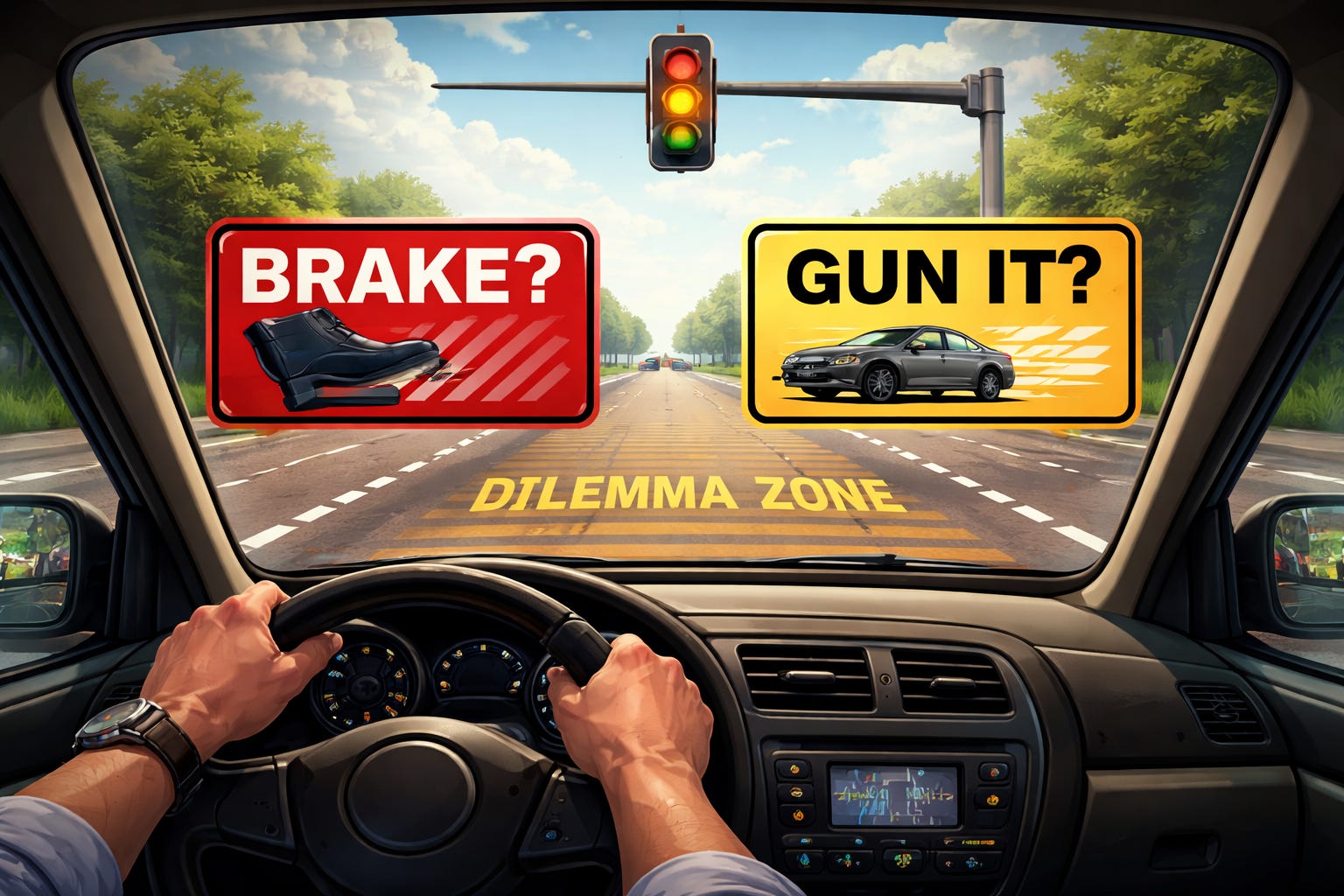
We’ve all been there: a light turns yellow just as you approach. Do you brake hard and risk a rear-end collision, or push through and risk running a red? That split-second decision isn’t always yours to make cleanly and a landmark 1959 study1 proved it.
The Dilemma Zone
Researchers identified what they called the “dilemma zone”, a stretch of road where you’re too close to stop safely, but too far to clear the intersection before the light turns red. You’re not making a bad decision. You’re trapped by bad engineering.
The fix is straightforward: yellow light timing should be calculated using physics, factoring in approach speed, vehicle size, and reaction time. A driver doing 45 mph typically needs four to four-and-a-half seconds of yellow. Most intersections don’t give it to them.
What the Data Shows
In a survey of over 70 intersections:
- Only one had a yellow light long enough to eliminate the dilemma zone.2
- On average, 1 in every 90 vehicles ran a red, most unintentionally.
- Some dilemma zones stretched longer than six car lengths.
The Bottom Line
The study called for two things: smarter light timing based on actual physics, and traffic laws that recognize not every red-light entry is a violation.
Neither has been universally adopted.
Next time you hesitate at a yellow, it might not be bad judgment. It might be bad engineering.
